There have been lots of cool new products released in the last month or so, some of which I have commented on here and others I looked at, then decided not to get. Here’s the round up of what I have decided against recently.
Not Upgrading
Reply

There have been lots of cool new products released in the last month or so, some of which I have commented on here and others I looked at, then decided not to get. Here’s the round up of what I have decided against recently.
Another month, another increase in our Comcast cable TV bill. One too far this time. Several months ago the bill had risen to a level where we thought it was too high for how much TV we watched & we trimmed a number of premium channel packages to reduce it to an acceptable level. Last month it was back up to that same amount even without those channels. It hadn’t jumped to that level though. Instead, it has been on a steady increase. Sometimes just a dollar or so, other times more. Always creeping up.
Meanwhile, we already had Roku boxes downstairs in the family room as well as in the master bedroom which provide us access to unlimited Netflix streaming for just $8 a month & Amazon Prime Video essentially for free since we have prime for the “Amazon Mom” program (if you never use the other elements of Prime, it would still work out at less than $8/month).
There was one wrinkle in the plan: the most common show we watched, when we had the chance to watch anything in the evenings, was House Hunters on HGTV. But we weren’t willing to pay that much for a few hours of TV each month. So, just before our trip to the UK, I called Comcast and canceled the TV service completely, and returned all the TV related hardware. But I kept the internet from them. Factoring in the increased price of “unbundled” Internet, that saves us about $110/month – over $1300/year.
Yesterday’s discussion around the ParaShoot camera project and whether it was doing any more than rebadging a Chinese ODM’s product, available in bulk on Alibaba already, for sale here in the US or actually developing something novel lead to some thoughts on crowd funding and what they can, or should, be applied to.
Manu Vollens (@manuvollens) proposed that crowd funding should only be used for disruptive projects:

Whether or not that applies to the ParaShoot project, I do think it is a little too restrictive on the funding model. One of the advantages of crowd funding is that in parallel with raising the money to fund your project you are also gauging the market’s demand for your project. But why should that be limited to disruptive projects?
A little while ago I backed a project on Kickstarter, a popular crowd funding service here in the US, for what was described as a wearable camera. I am actually not so interested in the wearable part as some of the other mounting options, like the car mount, that were promised to be in the “perk” package you receive for backing the project, assuming they are successful in raising the funds they need to complete the project, and they actually do complete it. There is always an element of risk in these projects (my Pebble watch was a Kickstarter project too, and while it was ultimately a success, and I love it, there were quite a few delays on the way).

The ParaShoot camera project blew through their $30K goal in no time, and were over $100K at the weekend when, out of the blue, Kickstarter suspended them. And suspension on Kickstarter is irreversible, essentially killing the project. At least, killing their Kickstarter campaign. ParaShoot has bounced back though, this time on the competing IndieGoGo site.
 Lots of announcements today (technically yesterday, but who’s counting) for new products from Sony and Samsung. The latter don’t interest me that much, and perhaps the reasons for that will be a future post, but the Sony announcement (which I had seen the leaks about beforehand) did include something of interest: a whole new camera concept.
Continue reading
 I read about this interesting new biometrics product, the Nymi bracelet from Bionym the other morning on the train, and at first I thought it sounded like a pretty smart solution to some of the problems with more conventional external biometrics.
But then I started thinking more about this, especially in light of an article I read by Glenn Fleishman about coping with the loss of a second factor device, and I started having doubts.
Continue reading
 A new toy arrived at the end of last week, having been ordered from the manufacturer’s eBay store a few days earlier: a bright orange ZTE Open smartphone, running FirefoxOS.
Box Opening
The mailing bag contained what looked like a brown box with the device name on it. That in fact was a sleeve around a more typical mobile phone box.
In the box was the device itself, a micro USB cable and charger brick, the battery and a (very cheap looking) wired headset.
Very simple to get into and everything you need to get started.
Anybody who has been paying attention to the news recently will know there are two threads running which directly relate to the trade off between security and our personal privacy. The most recent is the ongoing release by The Guardian of information mined from secret documents provided to them by Edward Snowden; the other is the trial and sentencing of Pfc Manning, convicted recently of leaking classified documents to Wikileaks.
I have been somewhat conflicted by these because, on the one hand it is important the people trusted to protect national secrets actually do that. But, on the other hand there really needs to be a way that violations of the law within that community can be reported properly, and are taken seriously.
Breaking the Law
In both cases, it is apparent that laws were broken. Those who work with national secrets (and I used to be somebody in that position, though not intelligence related) are trusted to maintain those secrets no matter what. In the UK, people who work regularly with such information are required to sign a copy of the law that protects these secrets. Not because it doesn’t apply until it has been signed – like any UK law, it applies to everybody in the country. We are made to sign it so there can be no doubt that we have read it, and understand what it means.
Simply disagreeing with something that is being kept secret does not change that. People trusted to protect national secrets are not (usually) the ones who get to decide when something is no longer a secret and can be released to the media.
But the law works both ways. The people in charge of these agencies are, by virtue of the fact that most of what they do is hidden from public oversight, trusted to be doing the right thing. As has become apparent over the last few weeks, even the politicians charged with over seeing the activities of these agencies have limited ability to really see what is going on. Instead they are left to trust compliance reports generated by the same agency. Can you imagine a public company being allowed to audit its own financials? Or school kids being allowed to grade their own test papers? Why are these agencies not audited by another part of the government?
I have seen nothing reported so far to suggest that the NSA has ever intentionally violated the rules set up to bound their activities. And to be honest, even though the number of violations sounds large in isolation, when presented as a percentage of the total number of queries they run, it is pretty small. Easily believable as unintentional mistakes. After all, the people running these queries are just human, and we all make mistakes. It is also apparent that they monitor & record violations of their policy, otherwise the report would not exist. Not really the behaviour expected of a rogue agency ignoring the rules; more like one staffed by humans, perhaps over worked ones at times.
Content vs Method
Another thing that stands out for me in all of this is that everything I have seen so far has been describing the methods used to gather intelligence. When dealing with encryption, it is often best to have the method well known, and well reviewed. It is the content that needs to be kept secret, not the algorithm. Obviously, that does not translate perfectly to all situations, but what is the harm in everybody knowing that the intelligence gathering agencies of the world are looking for the bad guys online? And that they have the ability to tap into lots of the pipes carrying traffic around the world? Does anybody really think the bad guys didn’t already assume that was happening?
There are clearly questions about how intelligently the technologies are being applied, but I think the public needs to come to terms with their expectations of privacy regarding Internet communication. Unless you take steps to protect it, I think you need to assume that anything you send over the Internet could be seen by any number of folks (for example, the sys admins in your office or at your ISP). I have always told less tech-savvy folks who ask me that email is more like a postcard than a letter. There is no envelope covering the contents while it is in transit. Luckily for us, most people, including those working for government agencies, likely have more important things to so than read the emails we send to our friends & family. And if you are posting on Facebook or Twitter, that is like pinning a notice on a community noticeboard. I don’t understand people who expect Facebook to be private – it is a platform for sharing.
Bottom line is if you are sending something sensitive (for example, the designs for a new product, drafts of a patent or the source of your application) in email, encrypt it. And choose a good, long pass-phrase or an asymmetric technology like public key.
Forcing criminals to avoid electronic communication for fear of being detected sounds like a good idea to me. Sure, it might be harder to see what they’re planning, but it is also much, much harder for them to coordinate & plan their attacks in the first place.
Crossing the Line
All of that said, two things today struck me as government crossing the line. Detaining David Miranda under the UK’s terrorism law, and demands for Pfc Manning to serve 60 years because he is still young both seem to go beyond reasonable.
Stopping Mr Miranda was almost certainly justified because he might be carrying classified material that he was not authorized to be in possession of. So, while technically legal, a very amateur move by the UK authorities. Had they been paying attention they would have read the excellent article in the NY Times magazine detailing the extraordinary measures Glenn Greenwald and Laura Poitras take to ensure the security of the material they have. Even assuming Mr Miranda was carrying anything of value, it would most likely have been encrypted in a way he could not decrypt (a simple public key method could achieve this goal, such that only Mr Greenwald could decrypt it using his private key).
It doesn’t end there though. Even if he had been carrying unencrypted documents, you would expect the people tasked with this kind of operation to understand that “recovering” them from Mr Miranda’s laptop, thumb drives or phones does not mean they are not still out there. Are they really naive enough to believe that by taking any copies he had they would stop Mr Greenwald writing anything more? Even before everything became electronic, paper documents or even film could be copied, so this should not be news to the people in the intelligence world.
As for Pfc Manning, does he really deserve to spend the rest of his life in prison? Was his crime really that serious? And does society benefit from locking him up many times longer than a murderer or rapist? What about those whose irresponsible actions led to the financial crisis we’re in, most of whom haven’t even been charged with anything despite negatively impacting orders of magnitude more people. It is clear nobody will entrust him with state secrets, but I am pretty certain he could contribute way more outside of prison than inside. Demanding he spend the rest of his life behind bars is just vengeful. So much for being a christian nation.
Intelligence or TSA
It was somewhat refreshing to hear that at least some part of the government was using intelligence (or at least trying to) rather than brute force to find the criminals who would attack us. Airport security has always appeared to me to be ineffective security-theatre, designed to make people feel safer as long as they don’t think too much about it. Always just reacting to the last attack vector, never predicting the next one. Catching criminals works better when you use intelligence and detective work.
Really, which is better: (a) having low paid bouncers at airports (or even train stations, arenas & along roads now) scare us into taking our shoes off and throwing away our bottled water & shampoo, (b) having intelligence analysts looking for patterns in electronic communications that could lead to thwarting an attack before it even made it out of the planning phase, or (c) doing nothing at all and letting these common criminals terrorize us all?
As more and more of the services we use every day become encrypted (think email, Facebook, Skype and even Google now), the ability to see patterns in the data captured from the infrastructure of the internet is reduced to just the patterns in the very limited meta-data about the connection itself. There is a certain elegance, at least from a technical perspective, in being able to tap into the data post-decryption in the data centers of the most common services. Unfortunately, it is a model that doesn’t scale (I think about scaling things a lot these days). There will always be services that are not included, or services like Lavabit that would never agree.
And I have to wonder whether the kind of criminals planning major attacks on us are really using Facebook to communicate. Seems pretty unlikely to me. I would have thought they would stick to less well known, and more secure services, likely using security like VPN tunnels or anonymisers like Tor. In which case, analysing the traffic going to Facebook and Twitter, or even Google would provide little or nothing of value.
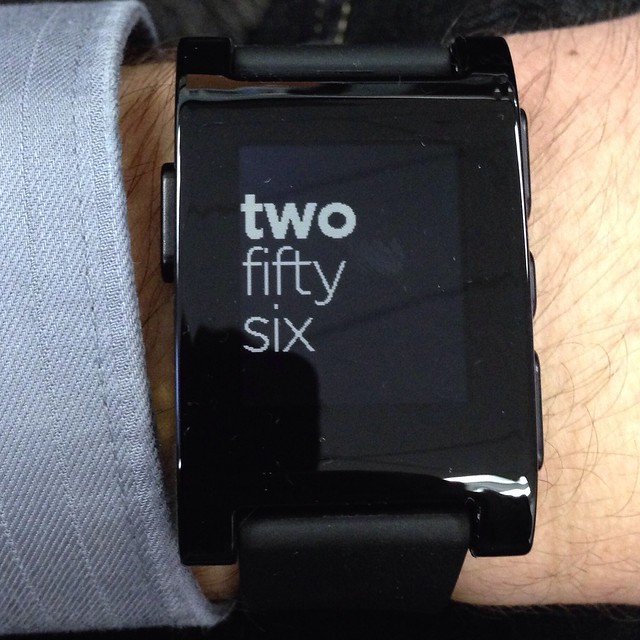 A while back I took delivery of my Pebble smart watch, and wrote up my initial reaction to the watch. Having lived with it for a while, I am still loving it (and it still gets comments and questions from people who see it). But everyday usage was starting to show too, with minor rubs and even one fairly annoying scratch in the center of the screen.
Polish or Wrap?
I started my mission to fix these scratches and restore the initial beauty of the watch by looking for polish products that might work. I did find one product that said it would work on Pebble watches, but while researching I found several people who had simply installed a screen protecting wrap over the minor scratching and could no longer see them.
In particular, it seemed people who had tried wet process wraps had great results covering scratches. So, I ordered a few different options from Gadget Wraps. I got four clear wraps, and a mix of their colored wraps to try if I fancy a different colour Pebble.
Installation
The process sounds complicated, but the video on their how-to page made it much clearer. Spray a fine mist of water on the wrap & on the watch, apply, slide until it is centered and then leave for 5-10 minutes before smoothing down the four arms of the wrap. The instructions then recommend you leave it for 24 hours after which it will be ready to wear again (it was tough being without my Pebble for a day!).
Bubbles & Scratches
The one thing the instructions say is that any bubbles visible just after fitting it will disappear on their own as it dries. That took longer than I had expected, but after 3 days I have no visible bubbles at all and I am very happy with the way it looks on the watch. I installed a clear wrap first, and you cannot tell it is there.
Even better, the scratches that were on the screen of the watch (when did watch faces become screens?), are totally invisible under the wrap.
Protection
Even if I had gone for the polish, I was going to install a screen protector. Perhaps it is just me, but I find I bump or rub the watch on too many things (my wedding band suffers a similar fate). Yesterday was the first time I noticed this after fitting the wrap; coming back from picking up lunch to notice paint rubbed off a wall onto the front of the Pebble.
A little hand sanitizer (which I find to be a great cleaning product) on my finger wiped it off the surface of the wrap & no harm was done to the watch.
Conclusion
They are not cheap (mine were $9 for two, but I got a promo offer of four pairs for the price of three, and because I bought that many, free shipping), but replacing the Pebble would be more & the polish products I saw worked out about the same without the benefit of future protection.
I am happy, and would certainly recommend them to a Pebble owner looking to protect their smart watch from the effects of everyday life.
One of the things that most ex-pats will likely need to deal with is calling home to friends and family, and doing so in a way that doesn't break the bank. When I first arrived in the US I used calling card services to call back to the UK, and while it was cheaper than regular international calling, it wasn't something I would want to do too often.
Now that has all changed, and there are a plethora of technologies available for solving the problem. I have three that I use regularly, and most of my calls are now free.
Call Centric
First on that list is a VoIP service called Call Centric. To make this work I set up my mother's house and mine with relatively cheap SIP adapters from Linksys' Sipura range, each connected to a regular cordless phone. That gave my mother something she was familiar with to call me. Her account is free since it is outside the US (phones located in the US need to pay a $1.50 monthly 911 fee), but she can only call my Call Centric number from it. My line also has credit loaded into it allowing me to call regular PSTN numbers anywhere in the world at competitive VoIP rates (calls to UK landlines are currently about 2¢ per minute, and UK mobiles about 20¢ per minute).
The time difference often means that the best time for me to call home though is not while I am at home. To solve that, I have a couple of tricks:
Call Centric covers almost all my voice calling needs, and apart from one time when they were being subjected to a DDoS attack, they have been very reliable.
I do also have two SIP clients on my iPhone, both configured with my Call Centric account, that I can use to make calls directly. The ones I have are Zoiper and 3CX.
FaceTime
The one service that we use that Call Centric doesn't work for is video calling. Having a toddler in our family who doesn't get to see his British family very often in person meant we needed a video calling solution too. As soon as my mother was equipped with an iPhone, that became a lot easier.
While not as flexible in terms of where we can make calls from, we have managed FaceTime calls from Starbucks and over hotel WiFi networks. It is a shame my AT&T plan doesn't allow them over LTE too, but since public WiFi is something I a more than a little familiar with, finding a hotspot to call from is rarely a problem. Most of our FaceTime calls are from home at the weekends anyway.
Skype
Relegated to something of a backup solution now, my mother and I both have Skype plans too. Before she got her iPhone, we used Skype video calling either with one way video to her first generation iPad, or two way video to her computer. I would say it was slightly less reliable than FaceTime, and usually lower quality images too, but it works across platforms which is a big advantage if either end of the call is not using Apple kit.
I also keep credit on Skype so I can use it to call her on her landline in case Call Centric fails for any reason.
Skype quality though has become very unpredictable. When it works, it is great, but all too often it will drop calls or the quality will disappear and noise is all we hear. I have heard good things about Viber as a possible alternative to Skype, but right now Call Centric and FaceTime are good enough that I don't need to look into an alternative to Skype just yet.