iPhone Progress

Lots of progress recently on the iPhone front (been busy with that, and a couple of other research projects for work, hence the lack of posts). Tonight I uploaded the source for a little tool called iOpener that combines the jailbreak function with the installation of the dropbear ssh server.

It is based on the well documented iPhoneInterface app developed by the folks at the iPhone Dev Wiki, but removes the shell function and replaces it with pre-programmed commands (the same way the jailbreak app automates the process of getting out of the chroot jail). It also employs the same trick as jailbreak to enable iTunes to function correctly as well (and therefore also supports the latest versions of iPhoneInterface).

For now you can download it from here. I’ll re-host it somewhere on bluedonkey.org soon. Next target for me is to get Devicescape‘a hotspot login application running on the phone… Since we have a Mac OS X version, I’m hoping it will port easily now there is a toolchain in existence.

iPhone Application Development

New iPhone ApplicationMaking some progress on getting applications installed on the iPhone. There is still a lot of work to do though, and the team over at the iPhone Dev Wiki (you can find them through their IRC channel: #iphone @ irc.osx86.hu, or using Google, but they ask people not to link directly) are making a lot of valuable discoveries towards this goal.

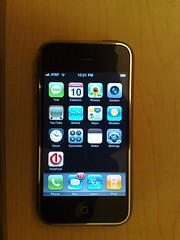
The photo, which is real, shows a new icon on the SpringBoard screen; the icon is Devicescape‘s and provides a clue as to what I am trying to add to the iPhone. Currently it just launches the FieldTest app though.

Nokia N95 vs Apple iPhone

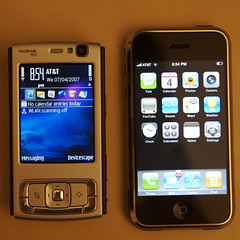
iPhone & Nokia N95I’ve had the iPhone for a few days now (and the N95 for over a month), so I thought I’d post a little comparison. There are plenty of other places out there with reviews and comparisons, and the N95 is the obvious phone to compare it to.

The first surprise with the iPhone though is how heavy it is. The N95 feels like a hollow shell by comparison!

Purely from the specs, the N95 has the iPhone beaten. That topic has been beaten to death everywhere, including a series of amusing YouTube videos in the Apple Mac vs PC style.

The UI though leaves the Nokia in the dust (and I’m not even going to talk about Windows Mobile – that should just be purged from the earth). Most of the apps make good use of the UI too, especially the flick scrolling.

Both devices are amazing, but both have their flaws too. The N95 interface is clunky at times, though even the stunning UI on the iPhone has problems – the keyboard is really hard to use. The camera on the iPhone is terrible, though the N95 one has issues at times too (I’ve had days, like today, when the auto-focus just refuses to lock).

The biggest thing that is missing from the iPhone though is simple: no third party applications. It comes with essentially 13 applications on top of the basic mobile phone behaviour. My N95 comes with over 20 applications, and I can add more very easily. I currently have Opera Mini, Google Maps, ScreenShot and, of course, Devicescape.

Save Internet Radio

SaveNetRadio.orgOf all the Wi-Fi enabled devices I own or use regularly (and since I work for a Wi-Fi company that’s quite a lot of devices) is my Roku Labs Soundbridge M2000. This amazing little device sits in our family room, connected to the Denon stereo system, and can play music either from my PowerBook’s iTunes library when I have it switched on, or more importantly to me from internet radio stations.

I’ve always been a big fan of radio (I tend to listen to radio in the car in preference to CDs, unless they talk too much or play too many commercials). Most nights I switch on the M2000 and listen to internet radio (currently Sky.fm‘s Best of the 80‘s channel).

But it seems that the exceptionally short-sighted and greedy music industry is trying to shut down internet radio by making them pay outrageous royalties on the music that they play. Quite why they should be paying more royalties than FM stations or satellite radio stations I don’t know. Seems stupid to me, so how about helping keep internet radio alive by heading over to SaveNetRadio.org.

Flickr Broken

Went to my Flickr contacts page this morning to see what my new photos were there, and I was greeted with this:

Thinking that it must be my browser I tried reloading, then I tried actually clicking through into the pages for the individual photos. But no, always a broken image 🙁

Update: Seems to be related to which of the servers your images are stored on. If your photos are on farm2.static.flickr.com then they appear to be broken; if you’re lucky, and your images are on farm1 then they’ll be working. Looks like somebody changed the DNS entries for the servers and one has made it through the system, the other hasn’t. More information in the Flickr forum thread.

Update 2: Looks like the problem is not Flickr, but rather DNS coming either from some providers in Europe or from FON. Another person reporting the issue here this morning was on a FON router.

Roomba EULA

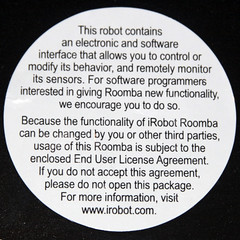
EULAI’ve had my Roomba for a couple of weeks now, and so far I am impressed. I’m impressed how well it finds its way around. I’m impressed with how well it actually cleans. But perhaps I was most impressed by iRobot as a company.

My first clue was that the schematic diagram of the Roomba in the manual included a description of where the serial port was. I had to double take. In all my dealings with consumer electronics in the Wi-Fi space, we’ve had to jump through hoops to get access to a serial port on a production device. In one case we had to add surface mount zero ohm resistors (anybody remember when these were just links?). And here’s a device that not only has the port accessible, but it is labelled in the user manual.

Then I found the sticker on the already opened bag. A EULA for a device? Surely not, but reading more I found: “For software programmers interested in giving Roomba new functionality, we encourage you to do so.” Now that is an enlightened company.

It is this kind of willingness to let others, including your end users, extend and improve your product that defines Web 2.0 and Mobile 2.0. Although most Roomba vacuuums are not connected to the internet, they are application specific devices, and they have an API and documentation for developers. If more consumer electronics devices came with this level of support for user experimentation the world might just be a little bit better off.

On the subject of Web/Mobile 2.0, I will be co-presenting a session about Mobile 2.0 on behalf of Devicescape at the Web 2.0 Expo this week. You can read more about that on the Devicescape Blog 2.0.

Mustek PF-A700B Picture Frame

So, I bought one of these digital frames a while back and just got around to trying it out. The frame has a roughly16:9 aspect ratio screen, so I was expecting to have to crop some of my images to that ratio so that they’d display nicely (it does also support a 4:3 mode, but that leaves black bars left & right on the screen).

Problem was that when I converted the images to the 480 x 234 resolution that the manual states the screen is, I ended up with black bars above and below and the image squashed down. Took me a while to work out what it was really doing… even in 16:9 mode it is expecting to be given 4:3 photos (which is what most digital cameras take). All it does is stretch them out to fit the screen, which distorts them.

My solution, after a little trial and error, was this process:

  1. Scale the image to be 960 pixels wide, preserving the aspect ratio. In my case, I got iPhoto to export them at that width, but you could do it afterwards too.
  2. Crop the image so that it is 960 x 468 pixels. I have this set up as a Photoshop action to take the centre slice, but for some images that is not the best crop and you’ll have to do those manually.
  3. Finally, scale the image to be 624 x 468 not preserving the aspect ratio in this case (so you effectively squash it horizontally). This will make it look very strange on the PC, but the frame will stretch it back out.

So you can see what the effect of the processing is, here’s a before and after pair from one of the photos I took in Mexico:

Before After

When the frame stretches this out again to the 16:9 ratio it will look normal. The reason for the additional resolution, despite the recommendation in the user guide not to exceed 480 x 234, is so that it has more pixels than it needs. When I tried the smaller images, they came out looking blurry. The 624×468 resolution seems to look OK unless you study it close up (and who does that with a framed snapshot?).

I have the steps above stored in an action in Photoshop so I can apply it to a batch of photos, store them on a CF card and then have them run as a slideshow. The quality of the screen is not stunning, but then I didn’t expect it to be for the price. What was disappointing was that I couldn’t just load native resolution images into it and have it just render them directly, but my simple image processing trick works around that problem nicely and I am happy with the results.

Getting Connected On Campus

This is one of three Devicescape commercials that are now available on YouTube (I’ll be posting the other two later this week as well). Have you tried it yet? If not, download it for free and check it out. You can get it for Windows XP, Windows Vista, Mac OS X, Windows Mobile, the Nokia 770 and 800 web tablets and the Linksys WIP300 VoWLAN handset.

Devicescape @ Demo 2007

For those that haven’t already seen it, the 6 minute presentation that Devicescape gave at this year’s Demo conference in Palm Desert is up on YouTube. I’ve embedded it here for your viewing pleasure too.

You can learn a little about Devicescape‘s hotspot login solution, and see some of the website too, but since it is free, why not just go there, download the software and try it?