Security Theatre

While prompted by the current outrages of the TSA, I wanted to write this in a more general way because they are not the only folks who employ security theatre instead of real security.

I’m actually going to start in Asia, at a company HQ where I had been invited to visit them to help an engineering team sort out a technical problem.

Serial Numbers & Tape
At the gate security of the company I was visiting (at their request, to help then solve a nasty technical problem), I was faced with a typical guard following his rules:

  1. The serial number of my laptop needed to be recorded.
  2. They had to make sure I didn’t have a camera, flash memory cards, thumb drives or an iPod on me. That means metal detector for me & x-ray for my bag.

At the door to the building, about 100 yards from the gate, the whole thing is repeated.

Leaving the building later in the day, the guard there dutifully checked the number on the laptop matched the one on their slip of paper. And then he tapes my laptop shut, making sure he covers the DVD drive, with anti-tamper tape. And they x-ray the bag again.

At the gate, we repeat the whole thing once more, and he checks the laptop is still taped up.

Now, I understand that there are risks of industrial espionage, but really, why tape my laptop up as I leave? By that point, if I was going to copy data on to it, or record conversations, it would be done. This is pointless security theatre. It will not stop anything at all. The only result of this security was I felt I was being treated as though I was a criminal (and believe me, I don’t want to return there ever again).

The Goal
Many years ago, I was told something about encryption techniques that is a very important thing to keep in mind: the strength of an encryption algorithm only needs to be good enough to protect the data until it is no longer important. Spending billions of dollars to implement a super-strength algorithm to protect data that only needs to be secured for a few hours is a waste of time & money.

At the same time, a solution that is 100% secure is impossible to achieve too. There is a trade off to be made between the cost and the strength, but there will always be a way to defeat it if somebody is determined enough to do so.

The same thinking applies to physical security. Reaching a solution where you catch 100% of the people who wish to harm us is unlikely. The trick is to find the balance where the cost (in this case both financial and impact on the lives of innocent travelers, who far outnumber those trying to harm us) is acceptable.

Theatre?
Calling it theatre though is to say that the people making these rules know that they don’t really add much security; they just inconvenience travelers enough to make them believe those in charge are on top of the situation. Let me tell you another story…

Last Christmas I was in the UK when that idiot tried to blow up his underwear on a plane, and I was flying home a few days later. Walking from the lounge (shopping) area at Heathrow to the gate, I thought it would be simpler to keep my laptop out (I’d been using it in the lounge area) since I was certain it would need to come out to be checked.

Within site of the new, hastily erected, gate entrance security check I was accosted by a United Airlines employee insisting I check my hand luggage. I started to explain that the laptop did fit in the bag, but since I could see it would need to come out just a few steps past her desk I thought it would be more efficient to just keep it out. Big mistake.

I got lectured about how the newly instated ‘one bag’ rule, as a reaction to the underwear bomber, was for my safety. And how dare I even think about whether that made sense. Smarter people than I had decided it made sense. But I do think about these things, and more people should.

Why does it make sense to limit people flying on US carriers to one carry on bag because somebody with no bags at all tried to set off a bomb in his underwear? Other carriers flying to the US were not affected by this rule.

But the theatre didn’t end there (and I guess, almost one year on, somebody at TSA finally noticed this glaring flaw). At the gate, after they had rifled through our one bag, they patted us down everywhere but the underwear area.

And this wasn’t theatre just to make people feel safer? Really?

Feel Safer?
Terrorist attacks are the biggest threat an American faces in their life, right? In the last decade, more people have been killed by terrorists than by any other cause, right?

Wrong! Here’s a quote from Ron Paul’s speech in the congress earlier this week with some numbers:

You know, when you think about it, if you look at what’s happened over the past 10 years, during this last decade, we lost 3000 on a terrible, terrible day for America. But since that time in this last decade, we have also lost 6,000 of our military personnel going over there and trying to rectify this problem. We have lost 400,000 people on our government-run highways. We have lost 150,000 individuals from homicides. So I think there’s reason to be concerned, reason to deal with this problem. We’re not dealing with it the right way, we’re doing the wrong thing, and groping people at the airport doesn’t solve our problems

So, the US government could save more lives (by two orders of magnitude) by simply banning cars. Too restrictive of your freedoms? OK, here’s something more shocking: Statistics from the CDC for 2007 (just one year in that decade), show heart disease and cancer killed over 1 million Americans. How about we take the money we’re wasting on security theatre at the airports, and spend it on improving the health of Americans? Or on defeating the evil that is cancer?

Sadly, the government can’t prevent every death, but doesn’t it make sense to spend in proportion to the threat?

Backscatter & Enhanced Pat Downs
The latest escalation of airport security theatre is special scanners than can see through clothing, and if you don’t like that idea for any reason, then you get an enhanced pat down, something that in any other setting would be considered sexual battery.

Obviously a reaction to the underwear issue, but is the high cost of this equipment and pat down policy, and even more important the infringement of a pretty basic human right worth the, at best, modest improvement in actual security.

Sure, if there is probable cause to believe somebody is a threat then escalating the intensity of the process makes perfect sense. Don’t treat every traveler as a threat to the safety of the aircraft. The numbers simply don’t support that assumption.

What are the numbers? Well, I found estimates online of 1.5 million to 2 million people flying every day in the US. Taking the low value there, that means more than 5 billion person-flights in the last 10 years. How many attackers have got on board aircraft in the US during that time? By my count, just 19. The shoe bomber and the underwear bomber boarded their planes outside the US, but add them in, and let’s add in the 8 liquid bombers from 2006 who never made it onto a plane thanks to some excellent detective work. Still a tiny, tiny number. Based on the number of murders/year, I would estimate there have been many more murderers than those 29 terrorists in Oakland alone over that same period of time. So why treat everybody like a criminal? We don’t treat everybody entering or leaving Oakland as a criminal.

Of course, you don’t need scanners if you want to limit your enhanced searches for people you suspect might be a threat – you can take those people into a private room, and use the techniques police forces have been using for years.

But how do you identify that needle in the haystack? The Israelis have been doing this for a while. They have a solution that focuses on exactly the problem of identifying people who might be a threat rather than assuming everybody is a threat and looking for their weapons.

“Anything For My Safety”
Really? Let’s ignore everything I just wrote and assume that body scanners and enhanced pat downs are the panacea that makes us 100% safe. So attacks on planes are no longer possible, the terrorists will all just go home to their caves and leave us alone, right?

No, of course not. They’ve already demonstrated that they are not limiting their attacks to aircraft (ask the folks in London and Madrid who saw attacks on trains and buses). Do you think we can fit those scanners to every train station? Every bus stop? Would that still be acceptable?

Perhaps we just shut down trains and buses (after all, you probably drive, so you wouldn’t miss them). I was in my early teens, going to school every day in the suburbs of London, when the provisional IRA set off a car bomb at the Harrods department store right before Christmas. Killing 6, and injuring 90 more who were just shopping for Christmas gifts. One of many bombs they set off while I was growing up. Do you want the backscatter scanners and pat downs at every mall too? Of course, that was a car bomb, so you’d need to scan the cars too.

Questioning The Rules Means They Win
Wrong! Making rules that unnecessarily restrict, humiliate or harm innocent people in any way is how they win. When we have to change our lives so dramatically, they win. When we are afraid to travel, they win. A terrorist’s end goal is not to bring down a plane, or destroy a train. The attacks are tools to strike fear into everybody.

Remember I said I was at school in a London suburb during one of the IRAs most violent periods. What did Londoners do? They carried on with their lives. Sure, a little more vigilance from everybody, but they didn’t put checkpoints at every station, bus stop and store. Even when the IRA killed a member of the royal family. The biggest “reaction” I can remember was to remove the cast iron garbage bins from the streets after the IRA dropped a bomb in one in Camden (cast iron bins become shrapnel when a bomb goes off inside one).

Conclusion
I believe today’s Americans could learn from the Londoners of the 1980s. Of course, the attacker, the threat and the root cause are different, but their end goal is the same. Don’t let them win.

You don’t need to be photographed naked or remove your shoes at airports if the security people are allowed to use some common sense. There are more types of profiling than racial profiling. I am pretty certain that the police and FBI here in the US use criminal profiling techniques every day (the FBI’s skill at profiling serial killers is world renowned). How about changing the TSA from being airport bouncers (with all the power trip problems that go with that rôle) into world class terrorist profilers?

Bay Bridge

Bay BridgeVery strange weather this morning, bright and sunny in Alameda and over the bay, with a backdrop of fog over the Oakland hills behind. Cool and grey over the city, and basically raining by the time I made it down to San Bruno!

This shot was taken with my iPhone 3GS from the Embarcadero in San Francisco looking out towards Alameda. The remains of one of the old piers in the foreground, with the Bay Bridge behind it and the sun shining off the bay made it look special enough for me to stop and take this photo.

Tax Season

US Tax Form 1040It’s that time of year again, when almost 140 million people in the US have to waste many hours of their personal time collecting information from forms sent to them by employers, banks etc, then enter it all into another set of forms to be sent to the federal and state tax services. Oh, and all that information has already been sent to those very same authorities. Just so they can check your answers? Is this some kind of annual test?


Wasted Time
The IRS estimates that on average across all people filing any type of federal return, individuals will spend 17.3 hours “preparing” these forms. The IRS reported (pdf) that in 2007 there were almost 139 million individual tax returns filed. So, a quick calculation suggests that every year in the US, 274,509 person-years are wasted on collating and transcribing information that the recipient (the IRS) already had. And that doesn’t include the burden from the state tax filings.

Wasted Money
In addition to the ridiculous amount of time wasted on this activity, the IRS also estimates that it will cost individuals on average $225 to prepare these returns; that’s $31 billion every year (and, again, doesn’t take into account state tax filing costs). That could be spent on things that were a lot more beneficial than collating and transcribing information from one set of forms to another.

Wasted Resources
It doesn’t end with wasted time and money either. Every year, employers, banks and other companies mail out those tax details to all their employees/customers. Some now offer electronic delivery at least, but I wonder how many of those end up being printed at home, either for reference while preparing taxes, for providing to an accountant or just for records?

Estimates online range from 9,000 to 15,000 sheets of paper per tree (obviously, the type & size of the tree plays a big part in this!). Let’s assume the 15,000 sheets per tree number for the sake of this post. That means, assuming each person filing a return received at least 5 of these forms (probably lower than reality based on my experience), 46,000 trees were destroyed to print these forms (and that doesn’t include the envelopes used to mail them – probably close to as much again).

Then there are the tax forms themselves. The IRS reported (in that same data book PDF) that about 79 million of the 139 million returns were filed electronically (a great achievement, by the way). That still leaves 60 million that were mailed in, on paper, though. My federal return from last year was 13 pages. For the sake of round numbers though, let’s say that the average person mailing in a return is 10 pages. That means another 70,000 trees were cut down to send the information to the IRS a second time.

Every year, that means over 100,000 trees are being destroyed every year just to pass this information around multiple times. And that doesn’t include the rest of the carbon footprint of this process (converting trees to paper, the resources used in printing, and the delivery of the forms).

A Better Idea
I don’t expect the US to do the smartest thing and switch to a taxed at source model, where companies who pay people are responsible for deducting the correct amount of tax before sending out the money, any time soon. I just don’t believe it is in the American psyche. Especially not when I hear so many people who are ecstatic to receive a refund from the IRS! They don’t seem to realise that all those refunds mean is that they gave the IRS an interest free loan for the year.

There is another solution though that would make much more sense than the current scheme: just bill me!

Yes, that’s right, the IRS (and the state tax authorities too) have all the information that they need to be able to calculate how much tax I owe, or how much they owe me. They have the resources to process that data, and it is all keyed off of a single identifier. So, why can’t they just send me a statement, and either a bill for what I owe or my refund? That would reduce the time most people spend on taxes to just minutes (the time required to scan the statement, and pay the bill).

The paper waste is also reduced dramatically. Let’s assume an average of 2 pages, printed double sided, per person billed, and 139 million bills mailed out. That’s under 10,000 trees now. Add electronic statements as an option, and no-fee bill pay options, and you also reduce the paper wasted by the process even further – assuming the same proportion of people who e-file their taxes, it would drop to below 5,000 trees per year – a reduction of over 95%.

Tax Reform
How about it President Obama? Democrats? If you want to make a meaningful difference to the tax system in the US, how about reforming the collection mechanism rather than individual taxes? It makes sense from a fiscal perspective; it makes sense from an enforcement perspective (less avoidance); and it makes sense from an environmental perspective. What’s not to like here?

Lava Tubes

Light at the EndPerhaps one of the strangest places we went while on the Big Island, this shot was taken from inside a lava tube. As you can see, no lava in there now – just water! It was actually raining outside while we were in here, so the shelter was quite welcome.

This was part of a very memorable day that started with waterfalls and then went through craters, steaming landscapes, sulphur fields, a ring, this lava tube and the glowing clouds of steam where hot lava poured into the ocean.

Comcast Closure

Well, it took a little while, but eventually Christina from Comcast’s national customer care center called me, and left me a number to call her back on. After a little phone tag, we eventually connected and she was able to see the payment that went to the transitional account as well as the ones to the new Comcast account. Something that none of the other people I’d spoken to at Comcast had been able to achieve (all claiming that I’d need to talk to the other group to get the problem resolved!).

Long story short, in a matter of minutes she managed to apply the old payment to the new account, and also credited me one month’s service to account for the increased price.

So, if you ever need to contact Comcast to get something resolved, skip the regular customer service and go straight to the national center. It is staffed by people who care, know how to fix things and have the authority to fix them too! Their email address is We_Can_Help@cable.comcast.com, or you can get them on Twitter too via @ComcastCares.

Hopefully somebody in Comcast’s upper management is going to take a look at the way the APT transition was handled and make sure that this kind of debacle can never happen again. The cost in terms of support calls and truck rolls could easily have been avoided (and in the current climate, avoiding unnecessary costs should be high on the agenda).

Comcast Fails (again)

Monday morning, at 8am, I call as requested to verify that I’m home and see if the technician can make it before 8:30am so I can catch my ferry to work. Unfortunately, it seems that the person I spoke to on Friday did not actually do what he said he’d done. There was no note in the account explaining the situation. So, once again I’m unable to get to work because I have to wait for Comcast to sort out their problems.

Just after 9am, the technician rolls up, looks at the problem and then discovers that he doesn’t have an HDMI DVR. I wouldn’t be too surprised at this normally, but for the fact that I had also talked to the person I booked the appointment with on Friday about that very topic to make sure that the person they sent out had an HDMI DVR with him. That too was meant to be in the notes. But it wasn’t.

The guy who turned up here this morning, when I mentioned that I’d specifically talked about HDMI to the person on the phone and that he’d promised it would be in the notes, simply replied that it was not unusual for them to miss information like that in the notes. He is now driving across Alameda to try to find another technician who has the right DVR on his truck for me.

So, by not making that simple note (despite saying he had), that tech support person on the end of the phone has managed to do three things:

  1. Waste my time, making me even less happy with Comcast;
  2. Waste the technicians time (he’s now got to drive around Alameda trying to find a compatible DVR);
  3. Made him late for all his other appointments this morning, upsetting even more Comcast customers.

The one comment I do want to add though is that the technician who came out here this morning did care enough to both call all the other Comcast people he knew were in the area, and his boss to find out if there were any others in the area, and then drove off to find one who had a compatible box. He could easily have just said I’d need to book another appointment. From his comments, it sounds as though they’re used to being given incomplete information, and having to work around it. That’s a sad indictment of the efficiency of the company though.

Update: As promised, the technician returned having tracked down a new HDMI DVR, and that is now installed and working. The real test will be what happens when a scheduled recording kicks off (which I need to set up again), but he was more confident of this box being more reliable than the new one I had before.

Comcast Disaster Continues

Oddly enough, the remote initialisation of the DVR did nothing to fix the problem with it crashing when it tries to record. I come in tonight to find it locked up in the same way as before.

I’m not yet convinced that this is a hardware issue though. So I am not expecting the box they bring on Monday to fix this issue unless it is a different unit (or has fixed software on it). Others are also having problems with the Motorola DCH3416, and Comcast’s service in general by the sounds of it.

And, yes, that’s yet another visit (my third so far) from the Comcast technicians – I asked tonight if they can book recurring appointments so they can just come out the same time each week and fix whatever has failed since the last visit. At the rate they’re going, they may as well just park out front.

From APT to Comcast

Sadly we found out a few weeks back that Alameda’s own cable TV company was no more, and that Comcast had acquired the service and all its customers. Until we were transitioned (more on that later) we would continue to get our cable and internet services unchanged. Right, so that’s why my DVR service was suddenly disabled on December 7, 2008. And that’s where this saga starts.

Continue reading

PowerBook Crash After 10.4.11 Update

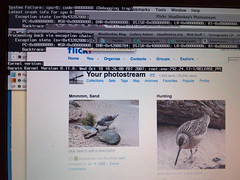
Not so good!This is the screen I was greeted with the other day when I woke my PowerBook up. I’ve done this for years without seeing any problems, then they updated to 10.4.11 and it now my poor PowerBook fails to wake up from sleep mode at least half the time.

Normally it crashes before the screen is woken up so I can’t see what’s going on. I’ve had a few crash reports on the next reboot (all pointing at a null pointer access in the video driver). Looks like somebody has screwed something up in the power management code of the video driver.

It is very annoying though, and takes a forced shutdown and reboot to get the machine back. Doesn’t take that long since Mac OS X boots fast, but it is still disappointing when the machine has been rock solid for the 5 years I’ve had it, and rebooting has been something I only do after updates. Oh, and the fact that this problem appeared just after the last “security” update makes me very suspicious of that update. Hope they fix it soon (I keep sending them the crash reports).

Monterey Octopus

OctopusThese guys are very hard to get photos of. They don’t like flashes, they live in relatively dark tanks, in a dark area of the aquarium and they’re hardly ever out in the open. And when they are out, there are throngs of people around the tank trying to get a good look at these amazing animals.